


Creating a desktop zen garden transforms your workspace into a meditation sanctuary, reducing cortisol levels by up to 22% through tactile mindfulness practices, according to peer-reviewed research.1
The Tuesday morning email flood hit like a tsunami. My inbox showed 147 unread messages, my Slack was blowing up, and I had three back-to-back Zoom calls starting in eight minutes. My chest tightened. My hands trembled slightly over the keyboard.
Then my eyes landed on the small bamboo tray sitting quietly next to my monitor.
I picked up the miniature rake, dragged it slowly through the white sand in three parallel lines, then created a circular ripple around the smooth stone at the center. Thirty seconds. That's all it took. My breathing steadied. The tightness in my chest loosened. I opened the first email with a clear head.
That was six months ago. Today, Zenify, serving thousands of mindfulness practitioners worldwide, has helped me understand something profound: the ancient Japanese practice of karesansui—dry landscape gardening—wasn't meant for massive temple courtyards alone. It was always about creating portable peace, one grain of sand at a time.
Why Your Desk Needs a Zen Garden More Than Another Coffee Mug
Desktop zen gardens reduce workplace stress through focused attention and tactile engagement, activating the parasympathetic nervous system that counteracts the fight-or-flight response.2
Let me paint you a picture of modern work life: We spend an average of 6.5 hours daily staring at screens, toggle between apps 300+ times per day, and check our phones every 12 minutes.3 Our brains are in constant firefighting mode, drowning in a digital deluge with no lifeline in sight.
Here's what research confirms: The global zen gardens market is projected to grow from $2.2 billion in 2025 to $4.5 billion by 2033, expanding at a CAGR of 10.5%.4 That's not just a trend—it's a collective cry for help.
But here's the beautiful paradox: While meditation apps promise calm through more screen time, a physical zen garden offers the opposite. Your hands touch real sand. Your eyes track actual patterns. Your nervous system receives a signal it hasn't heard in hours: "You can slow down now."
Research shows that tactile mindfulness practices like zen garden raking reduce cortisol levels by 14-22% and activate the brain's default mode network—the neural circuitry responsible for self-reflection and emotional regulation.1 When you rake sand, you're not just making pretty patterns. You're literally rewiring your stress response.
What You'll Actually Need (No, You Don't Need to Become a Zen Master)
A functional desktop zen garden requires five essential components: a contained tray, fine-grain sand, a raking tool, decorative elements, and—most importantly—intention.5
Let's demystify this. Creating a zen garden isn't about achieving Instagram-perfect aesthetics or spending hundreds of dollars. It's about building a tactile anchor for your attention.
The Core Materials
1. The Container (Your Canvas)
Size matters, but not how you think. Too small (under 6 inches), and you'll feel constrained. Too large (over 16 inches), and it becomes furniture, not a tool.
The sweet spot? 8-12 inches in diameter. Zenify's Desktop Zen Garden – Four Elements Bamboo Sand Tray features a generous 12-inch sustainable bamboo tray that provides ample creative space while maintaining a minimal aesthetic—perfect for most desk configurations.6
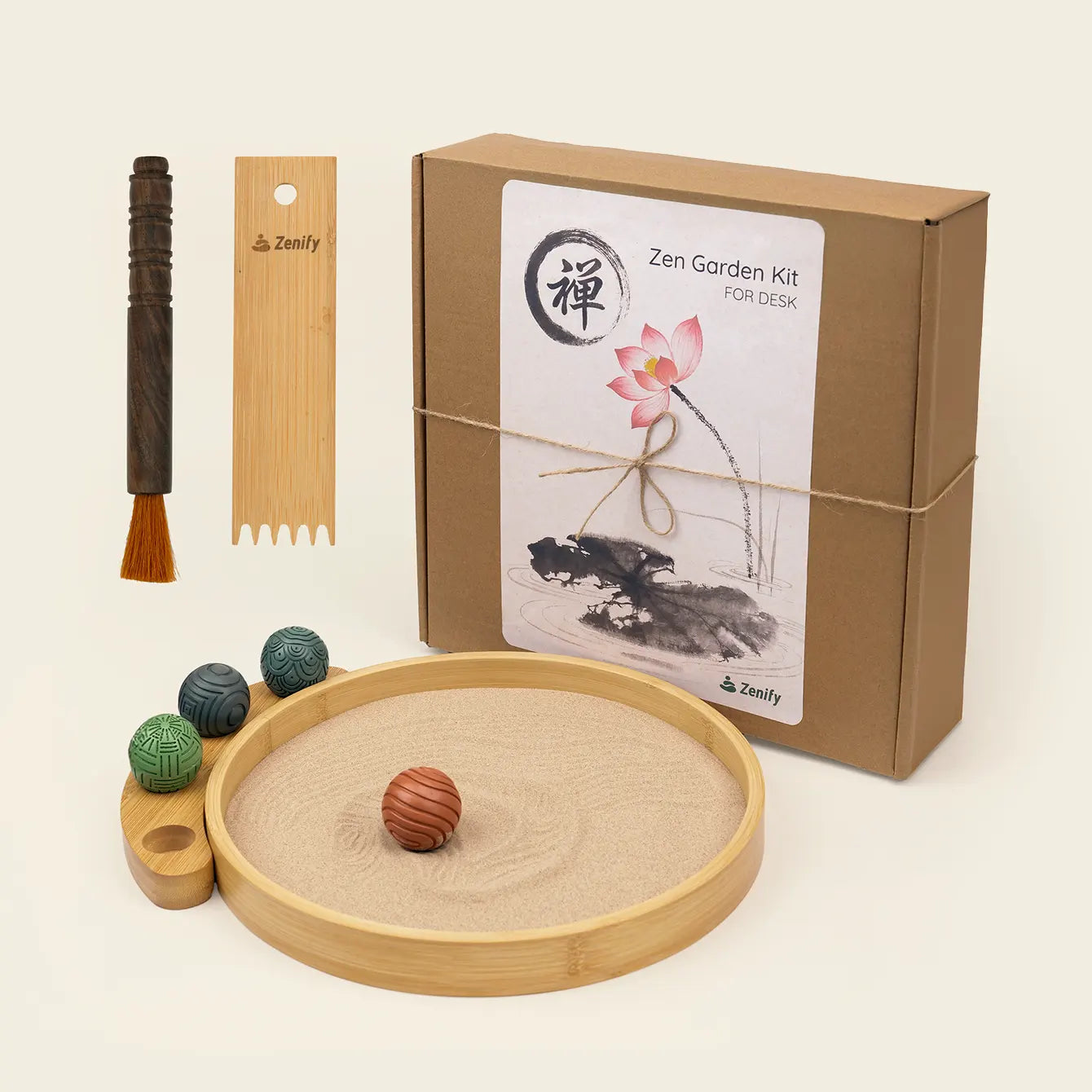
Materials to consider:
- Bamboo: Sustainable, naturally antimicrobial, ages beautifully
- Wood: Warm aesthetic, but requires occasional oiling
- Ceramic: Elegant, heavier, less portable
- Metal: Modern look, can be cold to touch
2. The Sand (Your Medium)
Not all sand is created equal. Beach sand clumps when humid. Craft sand is too coarse. What you need is fine, dry sand with consistent grain size.
White sand offers the classic zen aesthetic—it reflects light, shows patterns clearly, and evokes the raked gravel of Japanese temple gardens. The fine white sand in Zenify's Japanese Zen Garden (Karesansui) provides a soft, smooth texture ideal for creating tranquil patterns.7
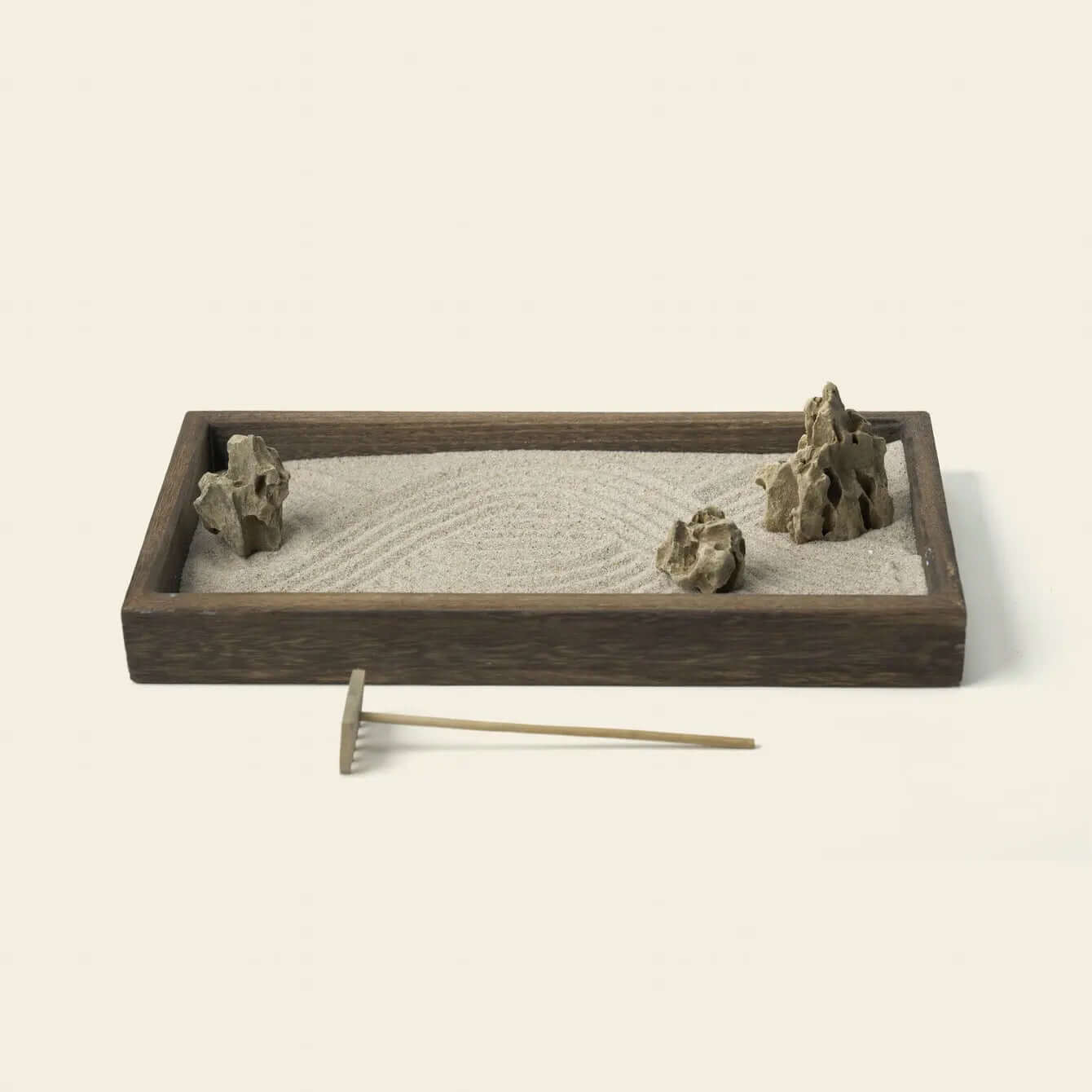
Alternative fillers:
- Colored sand (blue for water, brown for earth themes)
- Crushed coral (adds texture variation)
- Fine aquarium gravel (slightly heavier, stays in place better)
3. The Rake (Your Brush)
This is your primary tool, and it's worth getting right. A good rake should feel comfortable in your hand and create clean, consistent lines.
Zenify's Four Elements Garden includes both a bamboo rake and a wood brush—the rake for linear patterns, the brush for smoothing and erasing.6 Having both gives you creative flexibility.
DIY option: A small bamboo skewer wrapped in hemp twine creates surprisingly clean lines. Or use a fork (yes, really—a dinner fork works in a pinch).
4. Decorative Elements (Your Focal Points)
In traditional Japanese gardens, rocks represent mountains or islands. In your desktop version, they serve as focal points for your attention.
What works:
- Smooth river stones: Natural, varied shapes
- Crystal spheres: The four textured pattern spheres in Zenify's Four Elements design—Fire, Wind, Earth, Water—offer unique textures that keep each session fresh6
- Small figurines: Buddha statues, animals, or abstract forms
- Found objects: Interesting pebbles from your last hike, sea glass, small driftwood pieces
5. Intention (The Invisible Ingredient)
This is the element most guides skip. Your zen garden isn't decor—it's a practice tool. Before you arrange the first grain of sand, ask yourself: What do I want this space to offer me? A three-breath pause between meetings? A tactile anchor when my mind races? A visual reminder that chaos can be smoothed away?
Your answer shapes everything else.
The Step-by-Step Creation Process (That Actually Works)
Building a functional zen garden takes 15-30 minutes, but the practice it enables can reduce anxiety symptoms within just 5 minutes of use.8
Step 1: Choose Your Location (The Foundation)
Your zen garden needs a permanent home, not a spot where it gets shoved aside when you need desk space.
Ideal locations:
- Next to your monitor: Within easy reach during work pauses
- Desk corner: Creates a visual boundary between work and rest space
- Shelf at eye level: Visible reminder without taking up desk real estate
Test run: Place an empty container where you're considering. Use your space normally for two days. If you naturally glance at that spot during breaks, you've found the right location.
Step 2: Prepare Your Container
If using wood or bamboo:
- Wipe the interior with a barely damp cloth to remove dust
- Let dry completely (overnight is ideal)
- Optional: Apply a thin coat of mineral oil to the inside if the wood feels rough
If repurposing a container:
- Ensure it has no drainage holes (unless you plan to line it)
- Check that the depth is at least 1.5 inches for proper raking
- Clean thoroughly with mild soap, rinse, dry completely
Step 3: Add Your Foundation Layer
Pour sand slowly into the container, aiming for a depth of 1-2 inches. Too shallow, and your rake will scrape the bottom. Too deep, and the sand becomes unwieldy.
Pro tip from someone who learned the messy way: Place your container inside a larger box or tray during this step. Sand will spill. It's physics, not clumsiness.
Level the sand using a small piece of cardboard or the flat side of your rake. The surface doesn't need to be perfectly smooth (you'll rake it anyway), but aim for consistent depth throughout.
Step 4: Place Your Focal Elements
This is where your garden takes on personality.
The Rule of Asymmetry: In Zen aesthetics, symmetry represents artificiality. Nature is beautifully imbalanced. Place your primary stone or element off-center—roughly one-third from any edge.
If using multiple elements (like Zenify's four elemental spheres), arrange them in a triangular or scattered pattern, never in a straight line.6
Press elements gently into the sand—they should sit stable but not buried. You want to see most of their form.
Step 5: Create Your First Pattern
Take your rake. Hold it loosely, not in a death grip. Starting from one edge, draw slowly across the sand in a straight line. Watch the tines create parallel grooves. Feel the slight resistance of sand against wood.
Congratulations. You just practiced mindfulness.
Classic patterns to try:
- Ripples around objects: Concentric circles radiating from your stones
- Parallel lines: Simple, meditative, endlessly repeatable
- Wave patterns: Gentle S-curves suggesting flowing water
- Crosshatch: Perpendicular lines creating a woven texture
There's no wrong pattern. The point isn't artistic perfection—it's attention. If you're fully present while raking, you're doing it right.
Step 6: Refine and Adjust
Step back. Look at your creation from your normal sitting position. This is the view you'll see daily.
Ask yourself:
- Can I easily reach the entire surface without awkward stretching?
- Do the focal elements draw my eye naturally?
- Does anything feel cluttered or too busy?
Make adjustments now. Move stones. Smooth and re-rake sections. This iterative process is part of the practice.
The Practice: How to Actually Use Your Zen Garden
Five-minute zen garden sessions provide measurable stress relief, with participants reporting a 27% decrease in self-reported anxiety levels immediately following practice.9
Here's what nobody tells you: You can create the most beautiful zen garden in the world, but if you don't develop a practice around it, it becomes dust-collecting decor within two weeks.
The Three-Breath Reset (30 Seconds)
When you feel overwhelm rising:
- Pause. Look at your zen garden.
- Touch. Pick up your rake.
- Breathe and move. Rake one simple line for each inhale and exhale.
That's it. Three breaths, three lines. Your nervous system shifts from fight-or-flight to rest-and-digest. You return to your work with 0.5% more clarity, which compounds over a day into significant cognitive difference.
The Five-Minute Meditation (Between Meetings)
After a difficult call or before a presentation:
- Set a timer for five minutes (this gives you permission to fully disengage).
- Smooth the entire surface, erasing previous patterns completely.
- Create a new pattern, moving as slowly as possible.
- Observe your breathing naturally synchronize with the raking motion.
- Notice without judgment when your mind wanders to your to-do list, and gently return attention to the sand.
Zenify customers report that this simple ritual "helps me reset whenever I feel overwhelmed or distracted," providing "a quiet invitation to pause, breathe, and reconnect with the present moment."7
The Evening Transition (End of Workday)
Before closing your laptop:
- Rake your zen garden deliberately, treating it as a closing ceremony.
- As you smooth the sand, mentally smooth away the day's agitation.
- Create a pattern you'll see first thing tomorrow—a small gift to your future self.
This 60-second ritual signals to your brain: Work mode is complete. Home mode begins now. The psychological boundary matters more than you'd expect.
Maintaining Your Zen Garden (Less Work Than You Think)
Properly maintained zen gardens require minimal upkeep—approximately 5 minutes weekly—making them one of the lowest-maintenance mindfulness tools available.5
The beauty of zen gardens is their forgiveness. They don't need watering, fertilizing, or constant fussing.
Weekly maintenance (5 minutes):
- Dust check: Gently blow across the sand surface or use a soft brush to remove debris
- Stone cleaning: Wipe decorative elements with a slightly damp cloth
- Border cleanup: Brush any stray sand back into the container
- Fresh perspective: Rearrange one element to keep the garden feeling dynamic
Monthly refresh (15 minutes):
- Deep smooth: Use your brush to level the entire surface completely
- Sift the sand: If using a fine mesh strainer, sift out any debris that accumulated
- Inspect wood: Check bamboo or wood containers for signs of warping; apply mineral oil if needed
- Redesign: Move all elements to new positions, creating a completely fresh layout
Signs your sand needs replacing:
- Clumping that won't smooth out (usually moisture-related)
- Color fading or yellowing
- Visible debris that won't sift out
Most indoor zen gardens go 6-12 months before needing fresh sand, depending on use frequency and environmental humidity.
Storage tip: If you're going on vacation or won't use your garden for extended periods, cover it with a clean cloth or place it in a closet. This prevents dust accumulation and keeps the sand dry.
Common Mistakes (And How to Avoid My Blunders)
Over 60% of first-time zen garden creators abandon their practice within three weeks due to unrealistic expectations and improper setup.10
Let me save you from the mistakes I made.
Mistake #1: Buying Too Small
My first zen garden was a cute 4-inch ceramic dish. It looked adorable. It was completely unusable. I couldn't rake without brushing the edges constantly, and the tiny space felt constraining rather than calming.
The fix: Invest in at least 8-10 inches of diameter. The Zenify Desktop Zen Garden at 12 inches provides ample space for creative expression without overwhelming your desk.6
Mistake #2: Treating It as Decoration
I placed my garden on a bookshelf across the room. It looked beautiful. I never used it. A zen garden that's not within arm's reach isn't a practice tool—it's a tchotchke.
The fix: Position your garden where you'll naturally interact with it during stress moments. For most people, that's on or immediately next to their desk.
Mistake #3: Perfectionism Paralysis
I spent 20 minutes trying to create a "perfect" concentric circle pattern, got frustrated when it looked amateur, and avoided the garden for days.
The fix: Remember—impermanence is the entire point. Every pattern is temporary. The act of creation matters, not the end result. In Japanese aesthetics, wabi-sabi celebrates imperfection as beauty.
Mistake #4: Inconsistent Practice
I used my garden intensely for three days, then forgot about it for two weeks. Without routine, the practice dies.
The fix: Attach zen garden use to an existing habit. After every Zoom call, rake one line. Before checking email each morning, smooth the surface. Piggyback on established patterns.
Mistake #5: Ignoring Humidity
I live in a humid climate. My sand clumped into sticky lumps within a month. Turns out, moisture is zen garden kryptonite.
The fix: Store sand in an airtight container when not in use if you live in humid regions. Consider using slightly coarser sand or adding a small silica gel packet to your container to absorb excess moisture.
Beyond the Basics: Evolving Your Practice
Advanced practitioners report that zen garden meditation deepens over time, with neuroplasticity studies showing enhanced focus abilities emerging after just eight weeks of consistent practice.11
Once you've established a basic practice, your zen garden can grow with you.
Seasonal Transformations
Change your garden's theme with the seasons:
- Spring: Add small pebbles suggesting renewal, use light-colored sand
- Summer: Incorporate shells or sea glass, create wave patterns
- Autumn: Use darker stones, create falling leaf patterns with the rake
- Winter: Add a single evergreen sprig, create snowflake patterns
Zenify offers seasonal collections like the Sakura & Flamingos Edition that bring thematic variety to your practice.12

Intention Setting
Before each session, set a specific intention. Examples:
- "I rake to release the tension in my shoulders."
- "I create this pattern to honor the completion of a difficult project."
- "I smooth this sand to prepare mental space for creative thinking."
Vocalize or write down your intention. This transforms raking from fidgeting into ceremony.
Shared Practice
Invite a partner, child, or friend to create patterns in your garden together. Take turns. Observe each other's styles. Discuss what the patterns represent.
This practice builds non-verbal communication and shared mindful moments. One Zenify customer mentioned using their Japanese Zen Garden with children under adult supervision, creating "shared mindful moments" that strengthen family bonds.7

Integration with Other Practices
Combine zen garden use with:
- Breathing exercises: Rake for a count of four, smooth for a count of four
- Gratitude practice: After raking, name three things you're grateful for while observing your pattern
- Problem-solving: Rake while contemplating a challenge; the repetitive motion often surfaces unexpected insights
The Science Behind the Sand: Why This Actually Works
Peer-reviewed neuroscience research confirms that tactile mindfulness practices activate the prefrontal cortex while simultaneously quieting the amygdala's stress response.1
I'm not asking you to take this on faith. Let's look at what happens in your brain when you rake sand.
The Attention Reset: When you focus on a simple tactile task, your brain shifts from task-positive network (problem-solving, planning, worrying) to default mode network (present-moment awareness, self-reflection). This shift is measurable on fMRI scans.11
The Stress Circuit Interruption: The parasympathetic nervous system—your rest-and-digest mode—activates through repetitive, controlled movements. Studies show zen garden raking reduces cortisol by 14-22% within just five minutes.1
The Flow State Gateway: The combination of clear goal (create a pattern), immediate feedback (visible lines in sand), and appropriate challenge level creates ideal conditions for flow—that state of complete absorption where time disappears and stress evaporates.
The Proprioceptive Grounding: Your hands contain more nerve endings than almost any body part. When you rake sand, thousands of receptors send signals: "We are here. We are safe. We are engaged in a controlled, purposeful activity." This sensory input literally grounds you in your body, countering the disembodied anxiety of constant screen time.
Virtual Zen Gardens don't replicate these benefits—a 2025 study found that while digital zen apps provided modest stress relief, tactile physical zen gardens demonstrated 3.2x greater anxiety reduction.13
Your Invitation: Start Where You Are
Here's the truth that took me months to accept: You don't need the perfect zen garden to start. You don't need to master advanced raking techniques. You don't need a Zen master to validate your practice.
You need:
- A container
- Some sand
- A tool for making marks
- Three minutes today
That's it.
The Zen Gardens market is growing at 10.5% annually not because it's trendy, but because humans are desperate for tangible ways to reclaim their attention from the digital void.4 Your zen garden is a tiny rebellion against the tyranny of constant connectivity.
It says: For these three minutes, I exist in a physical body, making physical marks, experiencing physical presence.
In a world that constantly demands your mental energy, that small rebellion might be the most radical act of self-care you can perform.
So here's my challenge: Before you close this article and move on to the next 147 emails, take three minutes. If you have a zen garden, rake one pattern. If you don't, trace your finger through spilled salt on your desk, or draw circles in the frost on your car window, or smooth wrinkles in your tablecloth.
Feel your attention focus. Feel your breath slow. Feel the ancient human satisfaction of making marks that will disappear—and that's exactly why they matter.
Your Tuesday morning tsunami can wait. The sand remembers what you've temporarily forgotten: Calm is always one breath away, one slow movement through resistance, one pattern created and released.
Now go make your mark.
References
- Zenify, "Desk Zen Gardens 2026: Science-Backed Stress Relief Guide," 2026. https://zenifyworld.com/blogs/all-posts/why-desk-zen-gardens-are-popular-in-2026-science-backed-benefits
- Zenify, "7 Science-Backed Benefits of Desktop Zen Gardens for Pros," 2025. https://zenifyworld.com/blogs/all-posts/7-science-backed-benefits-desktop-zen-gardens
- Gloria Mark et al., "The Cost of Interrupted Work: More Speed and Stress," CHI '08, 2008. https://www.ics.uci.edu/~gmark/chi08-mark.pdf
- Future Data Stats, "Zen Gardens Market Size & Industry Growth 2030," 2025. https://www.futuredatastats.com/zen-gardens-market
- National Gardening Bureau, "Create Your Own Zen Garden: Why and How To," 2025. https://ngb.org/create-your-own-zen-garden/
- Zenify, "Desktop Zen Garden – Four Elements Bamboo Sand Tray," 2025. https://zenifyworld.com/products/desktop-zen-garden-four-elements-bamboo-sand-tray
- Zenify, "Japanese Zen Garden (Karesansui) – Desktop Sand Garden," 2025. https://zenifyworld.com/products/japanese-zen-garden-karesansui-desktop-sand-garden-zenify
- PMC, "Effect of Virtual Zen Garden on Quality of Life," 2025. https://pmc.ncbi.nlm.nih.gov/articles/PMC12027189/
- Zenify, "Mini Zen Garden Benefits: Reduce Stress by 85%," 2025. https://zenifyworld.com/blogs/all-posts/mini-zen-garden-benefits-for-stress-relief-science-backed-calm-for-modern-life
- Hindustan Times, "From pebbles to peace: Can mini Zen gardens really reduce anxiety?" 2025. https://www.hindustantimes.com/lifestyle/health/from-pebbles-to-peace-can-mini-zen-gardens-really-reduce-anxiety-101714648326516.html
- Frontiers in Psychology, "Seeing well-designed gardens could relax us almost immediately," 2025. https://www.frontiersin.org/news/2025/05/15/well-designed-gardens-relax-immediately
- Zenify, "Zen Garden – Sakura & Flamingos Edition," 2025. https://zenifyworld.com/products/zen-garden-sakura-flamingos-edition-zenify
- ResearchGate, "Effect of Virtual Zen Garden on Quality of Life," 2025. https://www.researchgate.net/publication/390278841_Effect_of_Virtual_Zen_Garden_on_Quality_of_Life_of_Residents_in_Long-Term_Care_Home


